



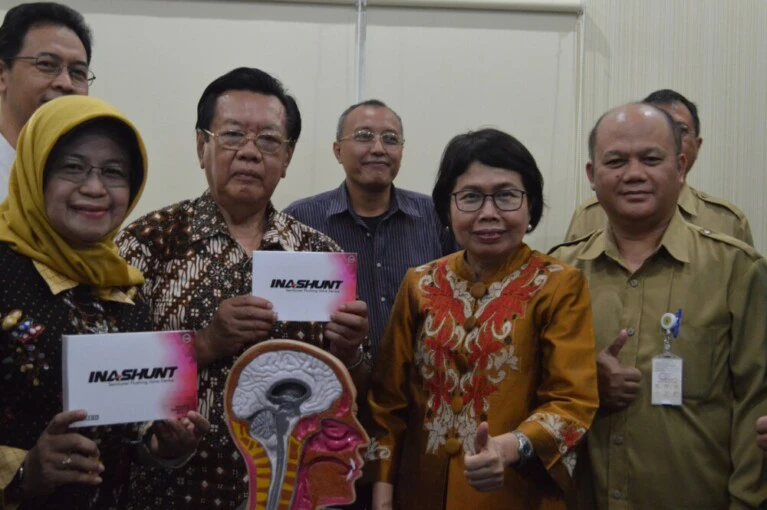
INA Shunt: A Solution for Hydrocephalus Sufferers
The advent of the shunt method offers hope for hydrocephalus sufferers. Moreover, the use of this method no longer relies on products imported from outside Indonesia.
The INA Shunt, developed by Prof. Dr. Paulus Sudiharto, Sp.BS(K), a neurosurgeon at Dr. Sardjito General Hospital, has become a solution. Production of the INA Shunt is entrusted to PT Gama Multi Usaha Mandiri, a Gadjah Mada University (UGM) company, through its subsidiary, PT Swayasa Prakarsa, which collaborates with PT Phapros Tbk for marketing.
“This is a semilunar slit valve system that is not only affordable but also reduces the risk of treating hydrocephalus patients,” said Sudiharto in a teleconference room in the Neurosurgery Room at Dr. Sardjito General Hospital on Monday (August 8th).
Sudiharto explained that the only best way to treat hydrocephalus is surgery. Surgery can remove the excess accumulation of cerebrospinal fluid within the skull. The operation involves the installation of a special pump and tube to drain the fluid.
Meanwhile, in 2013, the number of people with congenital hydrocephalus ranged from 14,216 to 18,955 (Indonesian Ministry of Health). Of this number, the majority of sufferers come from low-income families, resulting in many of them seeking medical attention too late.
Sudiharto explained that the INA Shunt was patented in September 2009 and has been in development since 1978. To date, it has been implanted in 10,000 hydrocephalus patients.
“There are various causes and ages, including birth defects, brain bleeding, infections, meningitis, tumors, or head injuries. Many forms of hydrocephalus result from obstruction of cerebrospinal fluid in the ventricles (middle part of the brain),” he explained.
The INA Shunt is a tube with a semilunar-shaped slit valve and anti-slip protrusions between them. This semilunar valve is attached to a pump and catheter system that drains excess cerebrospinal fluid from hydrocephalus patients.
“The advantage of this system is its semilunar valve, which prevents fluid from re-entering the head cavity and regulates the flow so that it is not significantly affected by patient activity. The anti-slip protrusions are intended to prevent the risk of the catheter tube being sucked into the brain cavity, which can cause death,” said Paulus Sudiharto.
According to him, the INA Shunt is a safe system for infants aged 10 days to adults, provided the patient is in stable condition. Installing a pump system from the brain to the abdomen can drain up to half the volume of cerebrospinal fluid in hydrocephalus patients.
“It has been widely used in Medan, Bangka, Batam, and other cities, but it is most widely used at Dr. Sardjito General Hospital. The INA Shunt costs around 2 million rupiah, much cheaper than foreign products,” explained Sudiharto.
After reviewing several hydrocephalus patients at Dr. Sardjito Hospital, Dra. Maura Linda Sitanggang, Ph.D., Director General of Pharmaceuticals and Medical Devices at the Ministry of Health, welcomed the launch of the INA Shunt for hydrocephalus patients. The INA Shunt demonstrates that this innovative medical device is based on collaborative research between Sardjito General Hospital, Gadjah Mada University, and the medical device industry.
“The INA Shunt has received distribution authorization from the Ministry of Health. Therefore, we strongly encourage the public to utilize innovative medical devices like this, especially since it will be included in the e-catalog so it can be used in all hospitals in Indonesia,” said Maura Linda.
The Director General of Pharmaceuticals and Medical Devices hopes that this innovation will be followed by other medical device innovations, as nearly 90 percent of medical devices in Indonesia still depend on foreign sources.
“But with domestic innovations, a health insurance program, and an independent and accountable procurement system such as an electronic catalog, all of this dependency can be gradually encouraged,” said Maura Linda.
Sang Kompiang Wirawan, S.T., M.T., Ph.D., Head of the Incubation Sub-Directorate of the Directorate of Business Development & Incubation at Gadjah Mada University, stated that the INA Shunt program demonstrates that academic research findings can be disseminated to the public after undergoing several testing stages. Therefore, the downstreaming process consistently expects full support from the Director General of Innovation Strengthening at the Ministry of Research, Technology, and Higher Education and the Director General of Pharmaceuticals and Medical Devices (UGM Public Relations/ Agung)