



Domestic Ventilators Boost Competitiveness of the Medical Device Industry
The Ministry of Industry (Kemenperin) continues to develop the downstreaming of national medical devices to achieve national self-sufficiency in the healthcare sector, while also encouraging import substitution. One medical device product being encouraged to be produced domestically is the ventilator.
The Director General of Metal, Machinery, Transportation Equipment, and Electronics (ILMATE), Taufiek Bawazier, stated that the presence of domestic ventilators will increase the competitiveness of the national medical device industry, enabling it to compete with global products.
For example, products from the consortium of PT Swayasa Prakarsa, PT YPTI, and PT Stechoq produce high-end ICU Ventilators and Emergency Ventilators. There are also Transport Ventilators, an innovation from the University of Indonesia, Emergency Ventilators from the Bandung Institute of Technology (ITB), and portable emergency ventilators from the Sepuluh November Institute of Technology (ITS).
“We should be proud that Indonesia has been able to produce high-end ventilators that are on par with foreign products. We must collaborate with the central government, regional governments, and various sectors of society to begin purchasing and utilizing domestic medical equipment,” said Taufiek on Thursday (October 20, 2022).
In an effort to optimize the use of domestic products, the Ministry of Industry is striving to include medical equipment products in the catalog of the Government Goods/Services Procurement Policy Agency (LKPP).
“Purchasing domestic products will boost the national industry and economy. The development of this industry will correlate with national prosperity and align with the development of the education and technology ecosystem,” said Taufiek.
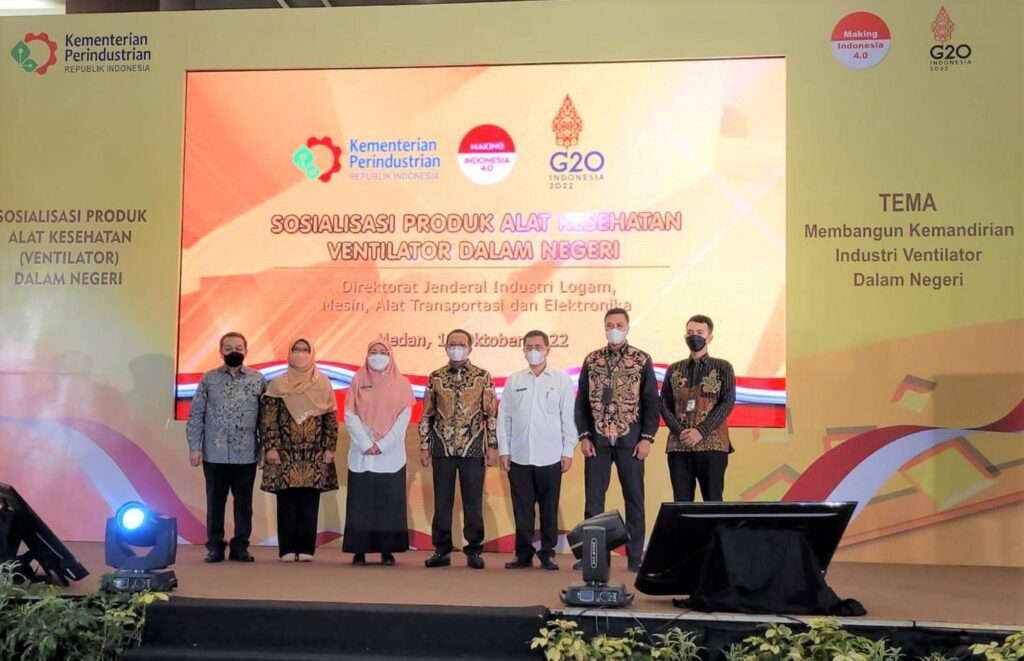
To achieve this goal, the Ministry of Industry is proactively promoting domestic ventilator products in several regions, such as North Sumatra. Through this activity, it is hoped that hospitals in North Sumatra will be informed that domestically produced ventilators are now available.
“These products, namely the ICU Ventilator V-01 and the Emergency Ventilator R-03, have distribution permits from the Ministry of Health. They have TKDN certificates with values of 43.16% and 41.90%, respectively, and can be purchased through the LKPP e-catalog,” Taufiek explained. With a TKDN value above 40%, these ventilators are mandatory items for government or state-owned enterprise procurement.
North Sumatra has potential for 35 regional general hospitals (RSUD), 171 private hospitals, 163 accredited hospitals, 615 community health centers (Puskesmas), and 23 accredited community health centers (Puskesmas). The total ventilator capacity in North Sumatra is 590 ventilators. Type B hospitals require 560 ventilators, Type C hospitals require 1,230 ventilators, and Type D hospitals require 310 ventilators.
“The North Sumatra Industry and Trade Office has been helping monitor the need for medical equipment in North Sumatra throughout the COVID-19 pandemic. We will increase the need for ventilators in the future to ensure that the UPT (Technical Implementation Unit) and Community Health Centers (Puskesmas) have ventilators so they can be used immediately if needed,” said Aspan Sofian, Head of the North Sumatra Industry and Trade Office.
This outreach event was also attended by representatives from PT Bank Sumut, who explained the financial institution’s support in facilitating user financing (hospitals) for investment or procurement of ventilator medical equipment.
“We are ready to support the increased use of medical equipment through financing schemes that will make it easier for hospitals in North Sumatra to purchase medical equipment, especially ventilators,” said Rudi Arif Panjaitan, a representative of PT Bank Sumut.
Editor: Eva Martha Rahayu